
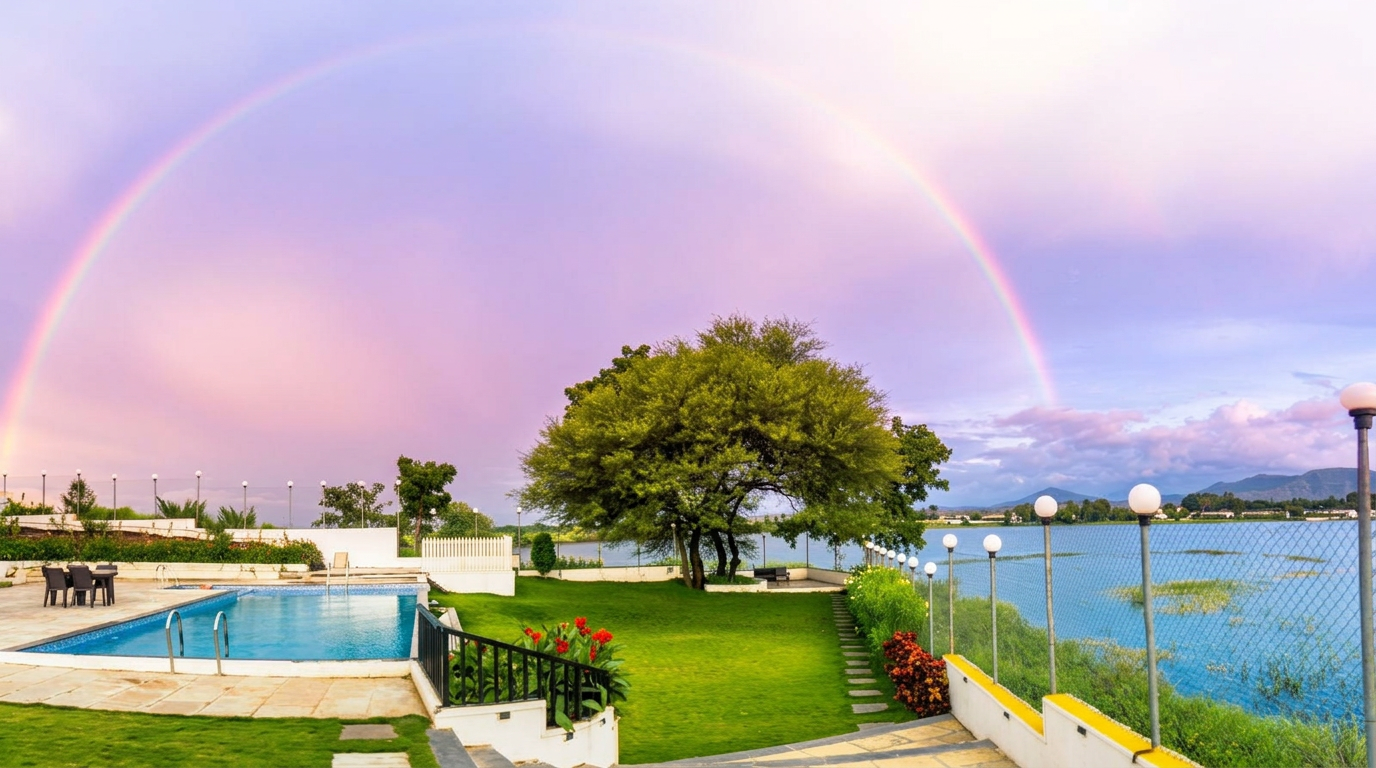
The short answer: the monsoon turns the countryside around Shirwal into a photographer's playground: rain over Wadgaon Lake, layered green hills, mist on the ghats, seasonal waterfalls and bright farmland. The best photos come in the light just after a shower clears, at sunrise and sunset. Protect your gear with a simple rain cover, shoot waterfalls only from safe viewpoints, and use a lake-view room at Avior Resorts as a dry base between outings.
Why the monsoon is special for photography
Between July and September, the hills around Shirwal go from brown to vivid green in a few weeks. Clouds sit low on the ridges, the lake fills, and every clearing shower brings a new sky. You don't need to go far: some of the best monsoon photos are taken within 30 minutes of the resort.
Monsoon photo spots around Shirwal
| Spot | What to shoot | Best time | Notes |
|---|---|---|---|
| Wadgaon Lake (at the resort) | Rain on water, moody skies, rainbows | After showers, sunset | Shoot from the room balcony or covered areas |
| Countryside around Shirwal | Green fields, farmers at work, winding roads | Morning | Ask before photographing people |
| Ghat roads towards Bhor and Wai | Mist, clouds, layered hills | Early morning | Pull over only at safe, wide spots |
| Wai and Menavali ghats | Temples and river in the rain | Morning | River can run high; follow closures |
| Satara region waterfalls | Seasonal falls in green valleys | Late morning | Official viewpoints only |
More on these areas: Shirwal monsoon local guide · waterfalls near Pune in the monsoon.
Timing your monsoon shots
- Right after rain: the air is clear, colours are saturated, and clouds break dramatically.
- Golden hour: the rare monsoon sunset through broken clouds is worth waiting for.
- Blue hour: with lights on at the resort, the lake reflects warm and cool tones together.
- Rainbows: look for them with the sun behind you after a late-afternoon shower.
Rain-proofing your gear
- A rain cover, or a plastic bag with a hole cut for the lens and secured with a rubber band.
- A lens hood keeps drops off the front element.
- Microfibre cloths, several of them.
- Silica gel packets in your camera bag.
- A dry bag for phones and spare batteries.
- Let gear acclimatise: moving from an air-conditioned room to humid air fogs lenses; take the camera out 15 minutes early.
Composition ideas for the monsoon
- Layers: use a telephoto to stack hills, mist and cloud.
- Leading lines: wet roads, field bunds and lake edges draw the eye.
- Reflections: puddles and still water double the sky.
- A splash of colour: an umbrella, a red sari or a yellow raincoat against green.
- Texture: raindrops on leaves, rain hitting the lake surface, water on a window.
- Scale: include a person or a vehicle to show the size of the landscape.
Phone photography in the rain
- Wipe the lens before every shot; one drop ruins sharpness.
- Use night mode for dark, overcast scenes.
- Shoot through a window with the lens flat against the glass to avoid reflections.
- Record short clips of rain on the lake; they're often more evocative than stills.
Safety first
- Stay behind barriers at waterfalls and viewpoints.
- Avoid slippery rocks and stream crossings.
- Don't stop on narrow ghat bends for a shot; find a wide, safe pull-off.
- Watch for closures announced by local authorities in heavy rain.
- Drive slowly with headlights on; see our monsoon drive guide for NH48.
A monsoon photo weekend from Pune
Saturday
- 10:00 am: Leave Pune; arrive Shirwal around 11:30 am.
- 12:00 pm: Lunch; shoot rain on the lake from covered areas.
- 3:00 pm: Drive the countryside lanes around Shirwal for fields and clouds.
- 6:00 pm: Back for sunset, if the clouds break.
- 8:00 pm: Dinner; review and back up your photos.
Sunday
- 6:00 am: Misty sunrise on the lake from your balcony.
- 8:00 am: Breakfast.
- 9:00 am: Drive to Wai's ghats for temple and river shots.
- 12:30 pm: Back to check out, or head home via Wai.
Editing monsoon photos
- Lift shadows to bring back detail in dark, overcast scenes.
- Add a little contrast and clarity to define clouds.
- Warm the white balance slightly if the scene feels too blue.
- Don't over-saturate the greens; they turn neon quickly.
Year-round photo ideas at the resort
For a guide to the best spots on the property in every season, see our Instagram-worthy spots at Avior.
Stay at Avior for your monsoon shoot
A lake-view room gives you a dry front-row seat to the monsoon. Stays include a welcome drink, dinner and breakfast.
- Call: +91 72619 62666
- WhatsApp: +91 72619 63666
- See rooms: rooms page · Enquire: contact page